We spent the morning studying weather reports and GRIB files, trying to understand what was coming our way — and whether it would be wise to hoist the spinnaker again after taking it down at 3:30 the previous night.
In the end, we decided against it and instead poled out the Code 0 on one side and the genoa on the other, supported by the main in second reef. It worked quite nicely — not as fast as the spinnaker, but solid — and we felt it gave us the flexibility we needed with squalls likely ahead. Both headsails can be rolled away quickly if the wind freshens, which gave us some peace of mind.
All went well for a while, and we enjoyed a wonderful dinner of pumpkin soup and Buchteln (pronounced “Wuchtln”) with custard.
I had just gone to bed about an hour earlier, when around 22:00 Akuna time, Mark suddenly yelled that there was a problem. And indeed, the Code 0 had come loose at the halyard – though the halyard had not broken.
By then the wind was around 20 knots. Not fully understanding what had happened, we hurriedly got the sail down — messy, but in one piece. The culprit turned out to be a wire holding the bowsprit (the extension pole at the front of the boat, where the foot of the Code 0 is attached), which had snapped.
Thankfully, no one was hurt. The repair should be straightforward once we reach Grenada, as the other end of the wire is located just above the waterline under the trampoline — very much an in-port job.
Having the main already reefed turned out to be a blessing, as we were able to keep sailing. But what followed was very unexpected.
Once the Code 0 was packed away, what we thought was a passing squall rolled through — except it wasn’t just a squall. With winds over 30 knots, it quickly turned into quite a ride.
Mark set the autopilot to “steering to wind,” meaning it constantly adjusts to hold the same angle to the apparent wind so the sails stay full. We retreated into our closed-off cockpit.
Luckily, we can hide from the rain extremely well. Everything can be sealed up, so we sat warm and dry in a cozy cockpit and adjusted the autopilot from inside — very comfortable, all things considered.
We assumed it would blow over quickly. Oh, how wrong we were.
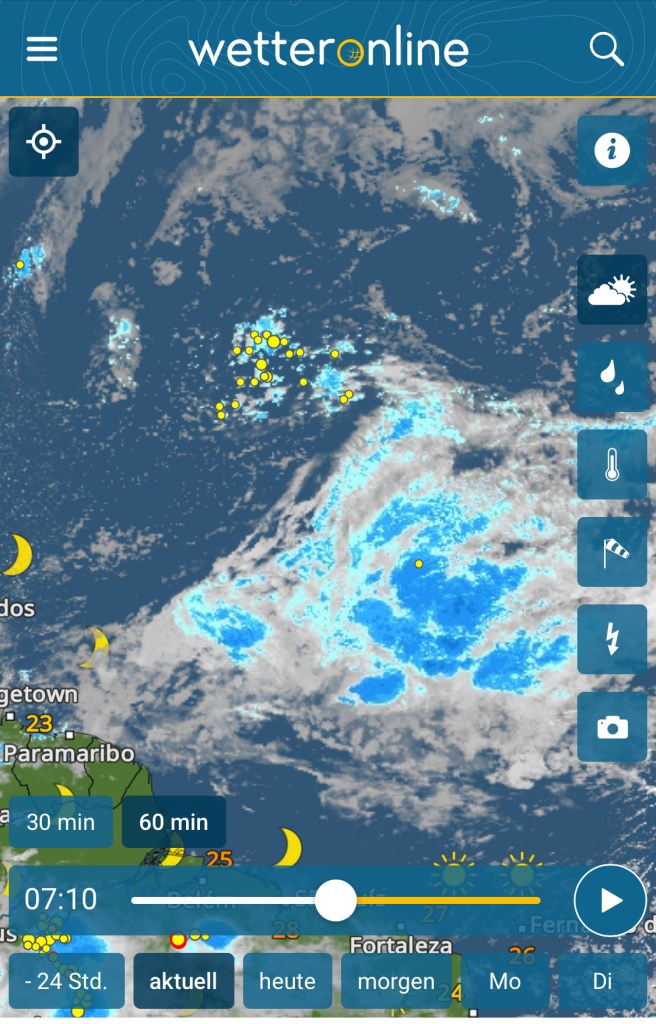
It lasted for over an hour, and since we had to run with the wind, it pushed us far north of our intended track (you might spot it on our Yellow Brick tracker https://pro.yb.tl/arcplus2025/ ). So there we sat — listening to the rain, watching the wind, tracking the squalls on radar, gybing again and again in an effort to escape a stubborn rain front that just kept regenerating.
Once conditions eased, I finally lay down to sleep so I could relieve Mark later. He couldn’t rest right away, but he would need it.
As I write this, I’m still dodging squalls — I’ve just had to gybe again. I suppose we’ve now arrived at “normal ocean crossing conditions.” Didn’t I say yesterday it felt too good to be true?
All things considered, we are still very lucky. No one was hurt, there’s no serious damage, and repairing the bowsprit should be a simple job. The Code 0 is still intact and only needs to be properly checked and furled. So really — no big deal, just annoying at most.
The boys were incredible throughout the whole episode, wrestling the sail down on the foredeck and still in good spirits afterward. And Neli too — I imagine he’s utterly exhausted and hopefully sleeping now.
What an amazing crew we have!!!!
(photos we made after I wrote the post!)


 sailing akuna
Leave a comment